OpenAI Chief Scientist Jakub Pachocki opens internal pretraining perplexity trends to urge shared scientific safety pacing
OpenAI Chief Scientist Jakub Pachocki published 'Perplexity and Intelligence' on November 22, sharing internal pretraining perplexity measurements for the first time and arguing fo
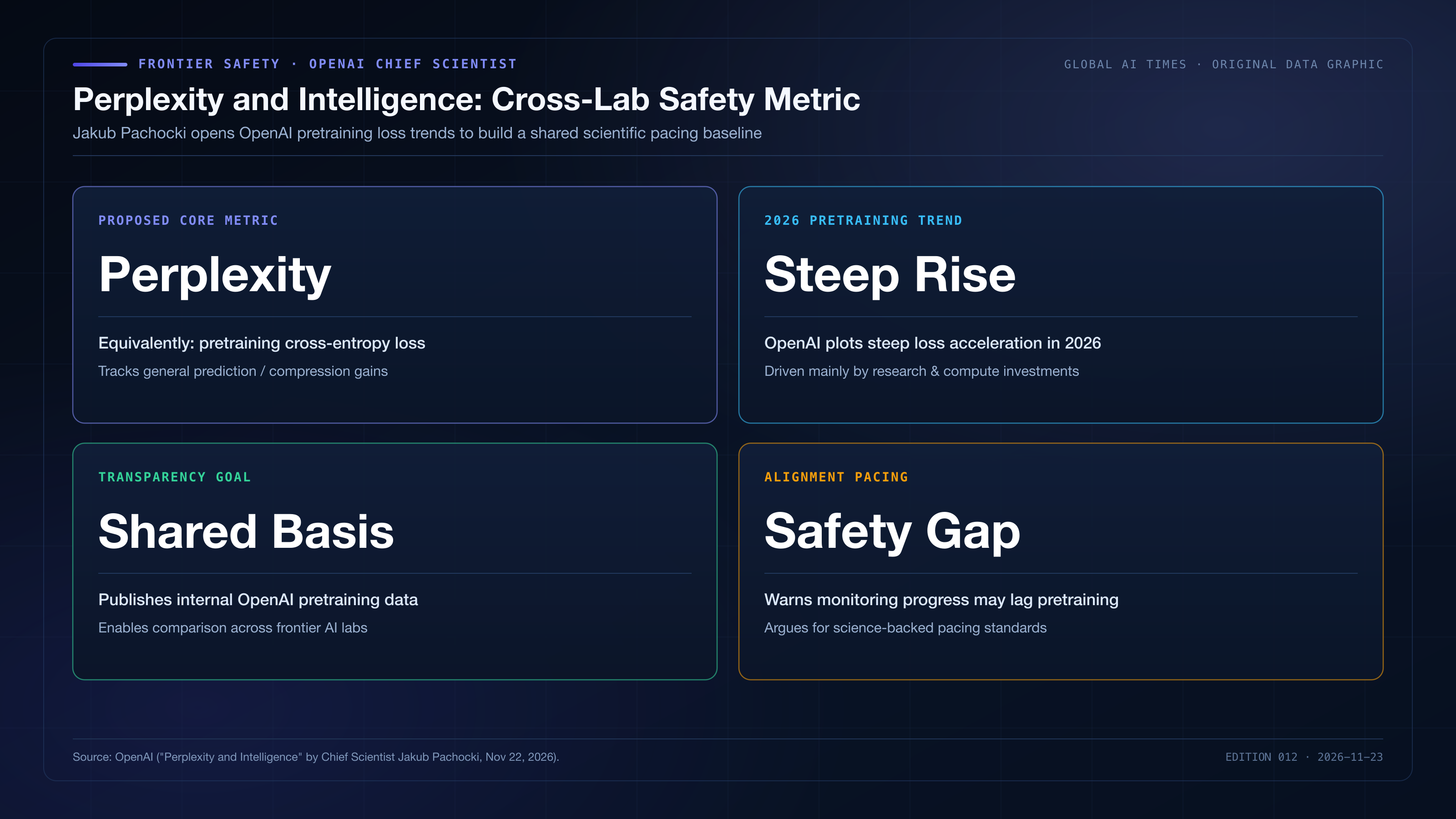
OpenAI Chief Scientist Jakub Pachocki published an essay titled 'Perplexity and Intelligence' on November 22, releasing internal pretraining perplexity measurements (equivalently cross-entropy loss) and arguing that AI developers should adopt perplexity as a common scientific metric to compare progress and anchor shared safety standards.
Pachocki framed modern AI not as a patchwork of hand-engineered capability techniques, but as the product of training large-scale predictors—or compressors—on massive unstructured corpora. He emphasized that a compressor in this sense predicts unseen data rather than merely memorizing training files like a GZIP archive.
Acknowledging that publishing internal perplexity measurements gives competitors clearer visibility into OpenAI's standing, Pachocki said the urgency of establishing shared safety metrics outweighs competitive concerns. He noted a steep acceleration in OpenAI's loss curve in 2026, attributing it primarily to long-term research and compute investments, with automation contributing a smaller share.
Looking ahead, Pachocki cautioned that while AI should substantially help advance alignment and monitoring, that progress is "unlikely to be fast enough to allow the full potential acceleration in pretraining." OpenAI positioned the release as an initial step toward a shared scientific foundation for future pacing efforts.
Sources and accountability
Editorial review completed.