MIT and collaborators introduce TideCache to accelerate hybrid LLM serving via dynamic cache pooling and layer-wise streaming
Researchers from MIT, ETH Zurich, and UC San Diego posted the TideCache preprint on November 19 (UTC). Adding about 9K lines to SGLang, TideCache achieves up to 2.04x more agent tu
Researchers from MIT, ETH Zurich, and UC San Diego submitted a preprint on November 19 (UTC) presenting TideCache, a serving system for hybrid-architecture large language models. As open-weight models increasingly combine global-attention layers with bounded-state layers such as sliding-window or recurrent mechanisms, their heterogeneous cache demands shift sharply with context length and concurrency, straining static GPU memory partitioning.
Built for CPU-GPU superchips, TideCache combines three core components: a Transparent Cache Pool, a Cache Streamer, and a Request Scheduler. The Transparent Cache Pool redistributes physical HBM pages between bounded-state and global-KV pools behind fixed virtual addresses, preserving existing cache layouts and attention backend interfaces.
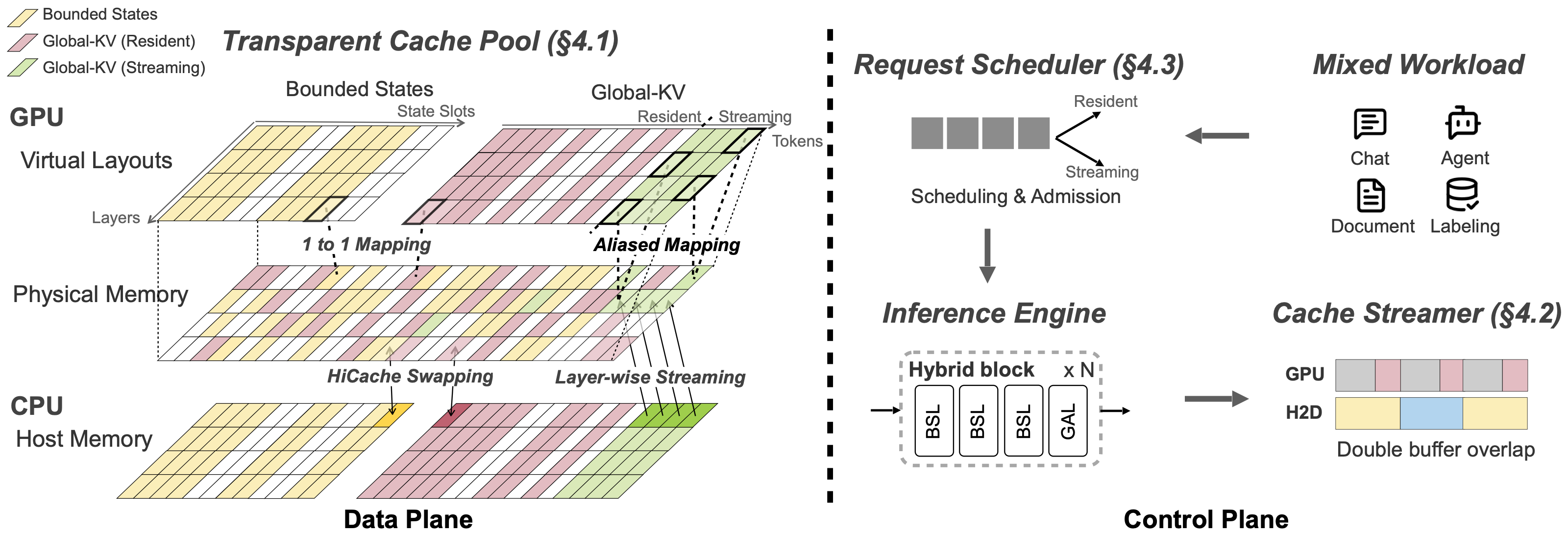
For long-context workloads, the Cache Streamer leverages computation intervals in bounded-state layers to double-buffer and prefetch the next global-attention layer's prefix KV from host memory into shared GPU slots, overlapping host-to-device transfers with compute while keeping newly generated KV resident. The Request Scheduler selects resident or streamed execution and triggers capacity adjustments based on request size and queue state.
Implemented in roughly 9K lines added to SGLang, TideCache supports multi-head, latent, and sparse-indexed global attention alongside sliding-window and recurrent states while preserving CUDA graph execution. Evaluation spans seven model-platform configurations on NVIDIA GB300 (288 GB HBM3e per GPU, 211 GB/s measured NVLink-C2C H2D bandwidth) and GH200 (96 GB HBM3), covering Kimi K3, Ring-2.6-1T, GLM-5.3-Flash, Qwen3.8-27B, Qwen3.8-2.4T, and GPT-OSS-120B.
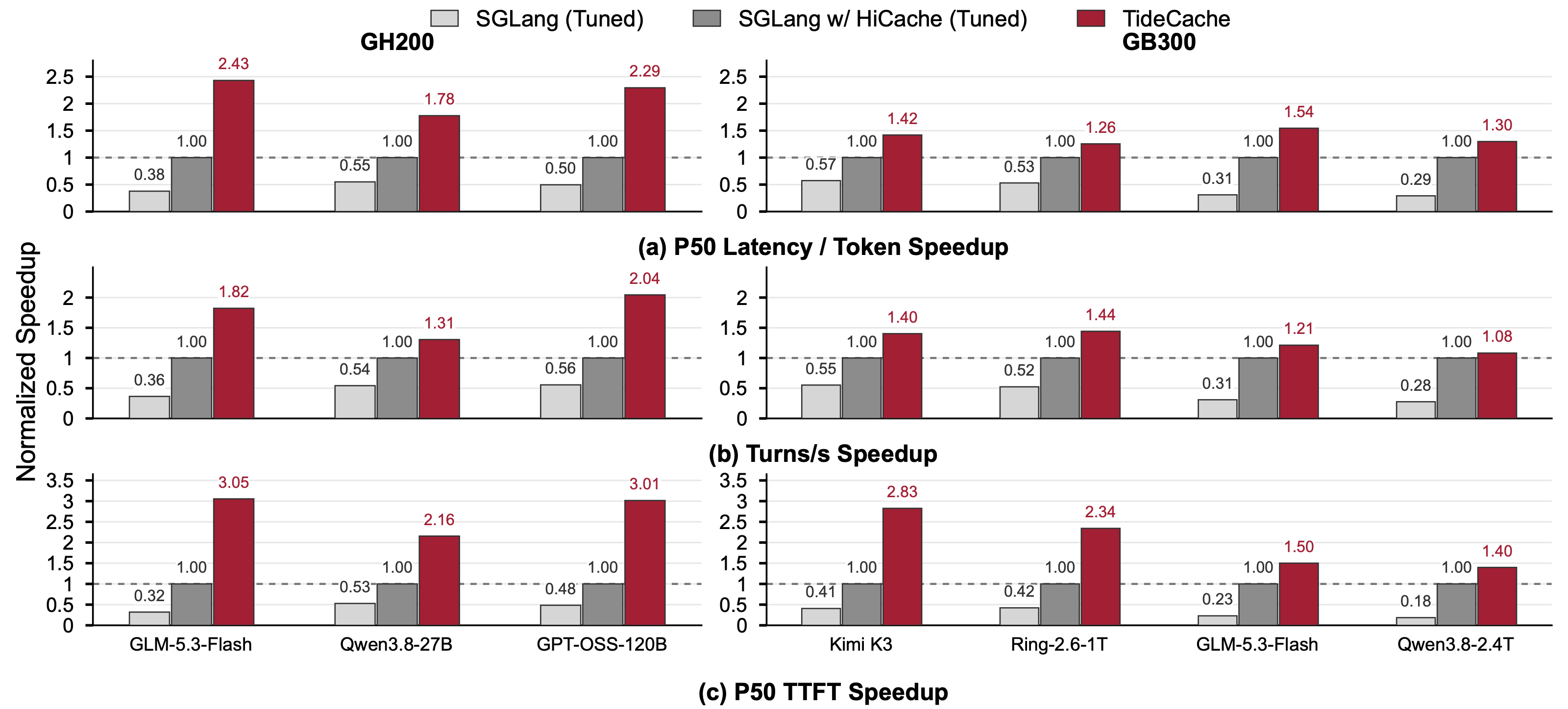
On synthetic mixed workloads combining ShareGPT traces with multi-turn Claude Code traces released by SemiAnalysis (40K to 110K token contexts and 8 to 28 turns), the authors report up to 2.04x higher agent-session turn throughput, 20% to 59% lower overall P50 per-token latency, and 1.40x to 3.05x faster agent P50 time-to-first-token (TTFT) compared with tuned SGLang with HiCache.
This report is based on the preprint and has not undergone independent reproduction or peer review. Notably, the Kimi K3 and Qwen3.8-2.4T experiments used their first 48 and 36 layers respectively to fit within HBM, and the reported gains rely on high-bandwidth NVLink-C2C interconnects on GB300 and GH200 superchips; behavior on standard PCIe servers or other live traffic mixes remains to be verified.
Sources and accountability
Editorial review completed.