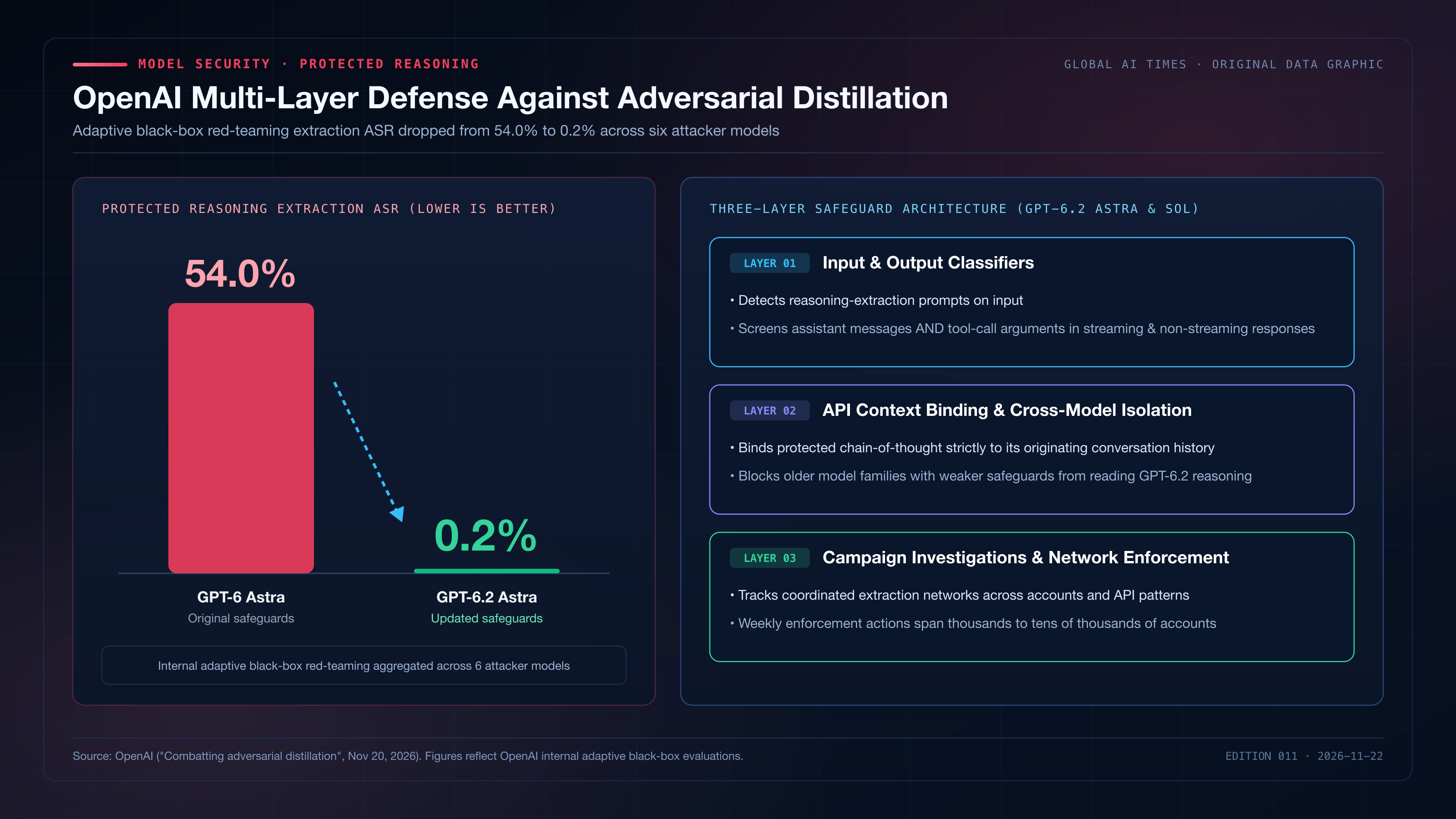
OpenAI details layered defenses against adversarial distillation, reporting reasoning extraction ASR drop from 54.0% to 0.2%
OpenAI published an overview on November 20 detailing multi-layer safeguards against unauthorized adversarial distillation, focusing on protecting models' internal chain-of-thought
OpenAI published a technical post on November 20 outlining how it detects and disrupts adversarial distillation. Beyond intellectual property concerns, OpenAI framed unauthorized distillation as a safety risk: bad actors can train a second model on frontier outputs to reproduce capabilities in dual-use areas such as cybersecurity and biology without inheriting comparable safeguards.
OpenAI highlighted protecting exact internal reasoning traces as central to cyber safety. In internal teacher-student experiments trained on coding and defensive cybersecurity trajectories, student models trained on exact reasoning traces generally outperformed those trained on reasoning summaries after supervised fine-tuning and remained stronger at the largest tested inference budget after reinforcement learning.
In GPT-6.2 Astra and GPT-6.2 Sol, OpenAI combines request-level mitigations with campaign-level investigations. Input classifiers flag extraction attempts while output classifiers screen assistant messages and tool-call arguments across both streaming and non-streaming responses. At the API layer, protected reasoning is bound to the conversation history that produced it, and older model families with weaker safeguards are blocked from reading GPT-6.2 Astra and Sol's protected reasoning.
In OpenAI's internal adaptive black-box red-teaming aggregated across six attacker models, average attack success rate for recovering protected reasoning dropped from 54.0% on GPT-6 Astra with its original safeguards to 0.2% on GPT-6.2 Astra with updated safeguards; these figures reflect OpenAI's internal evaluations. At the campaign level, OpenAI reported weekly enforcement actions ranging from thousands to tens of thousands of accounts—rising significantly over the past summer—and noted an earlier disrupted campaign with a core part attributed to individuals associated with Moonshot AI.
Sources and accountability
Editorial review completed.