NIST and UMD-led SoK: Disclosed CVEs more than doubled in 2026 as LLM agents reach autonomous vulnerability discovery
Researchers from NIST, the University of Maryland, and Université Grenoble Alpes posted a Systematization of Knowledge preprint on November 19 (UTC) assessing LLM autonomy in real-
Researchers from the National Institute of Standards and Technology (NIST), the University of Maryland, and Université Grenoble Alpes (CNRS) submitted a Systematization of Knowledge preprint on November 19 (UTC) evaluating LLM evolution in software vulnerability research. Borrowing from driving automation levels, the framework scores autonomy alongside correctness, access tier, and evidence strength across 503 verified statements.
Drawing on direct real-world software evidence through November 7, 2026, the authors find that agents already discovered, validated, and patched vulnerabilities without human intervention (A4) by October 2025, with open-weight models matching comparable autonomy for discovery and validation within months and reaching expert correctness (A4·C2) across access tiers. The paper also cites lab and independent evaluations where restricted frontier agents selected targets and completed end-to-end attacks (A5·C1).
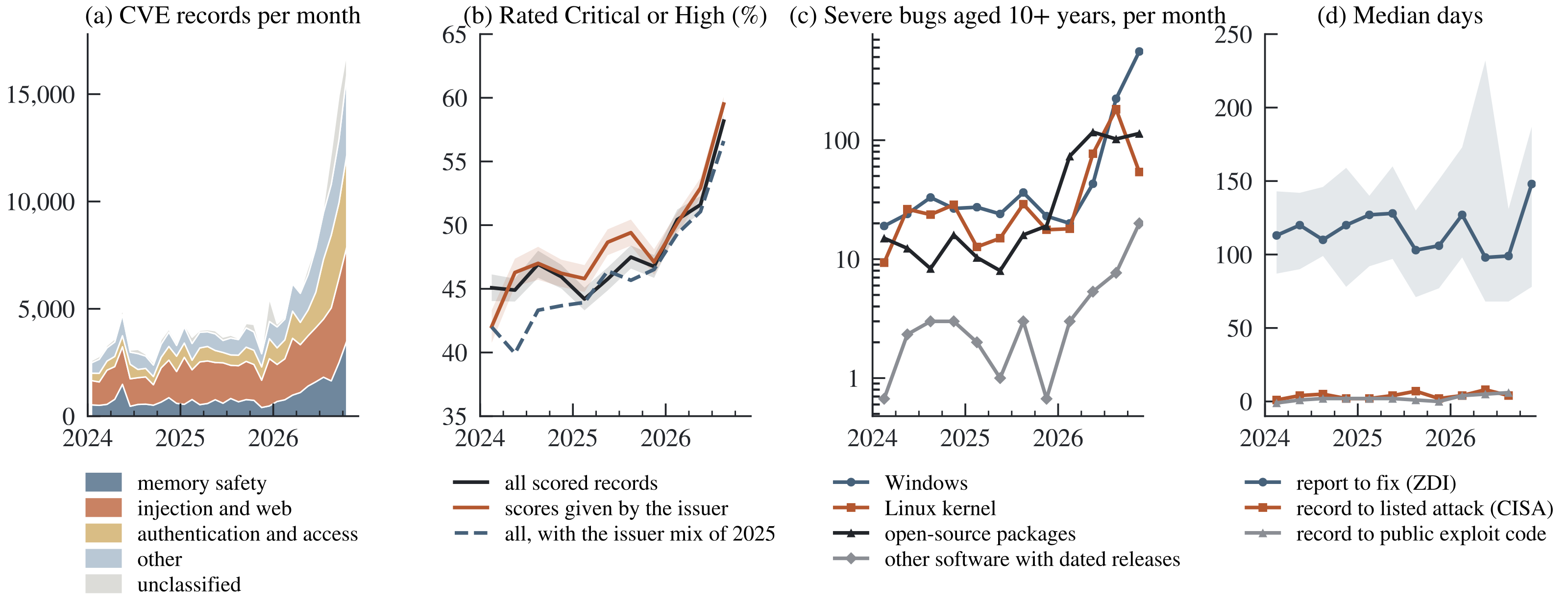
In public records, CVE disclosures from January to October more than doubled from 39,638 in 2025 to 89,749 in 2026, with monthly totals nearly quadrupling from 4,302 in January to 16,949 in October. Six issuers—GitHub, VulnCheck, Oracle, the Linux kernel, Chrome, and Microsoft—accounted for two thirds of the increase. Vendor self-issued records rose 2.8x versus 1.6x for third-party issuers, while records explicitly crediting an AI finder rose from 268 in 2025 to 2,290 in the first ten months of 2026.
Severity shares also climbed: scored CVE records rated Critical or High rose from 46% in 2025 to 56% from July to October 2026. Among codebases with dated vulnerability ages, Critical or High bugs aged ten years or older were reported 6 to 11 times as often per month as in 2025. Meanwhile, among 2026 records naming a finder, first-time finders received 70% of credits, up from 51% in 2025.
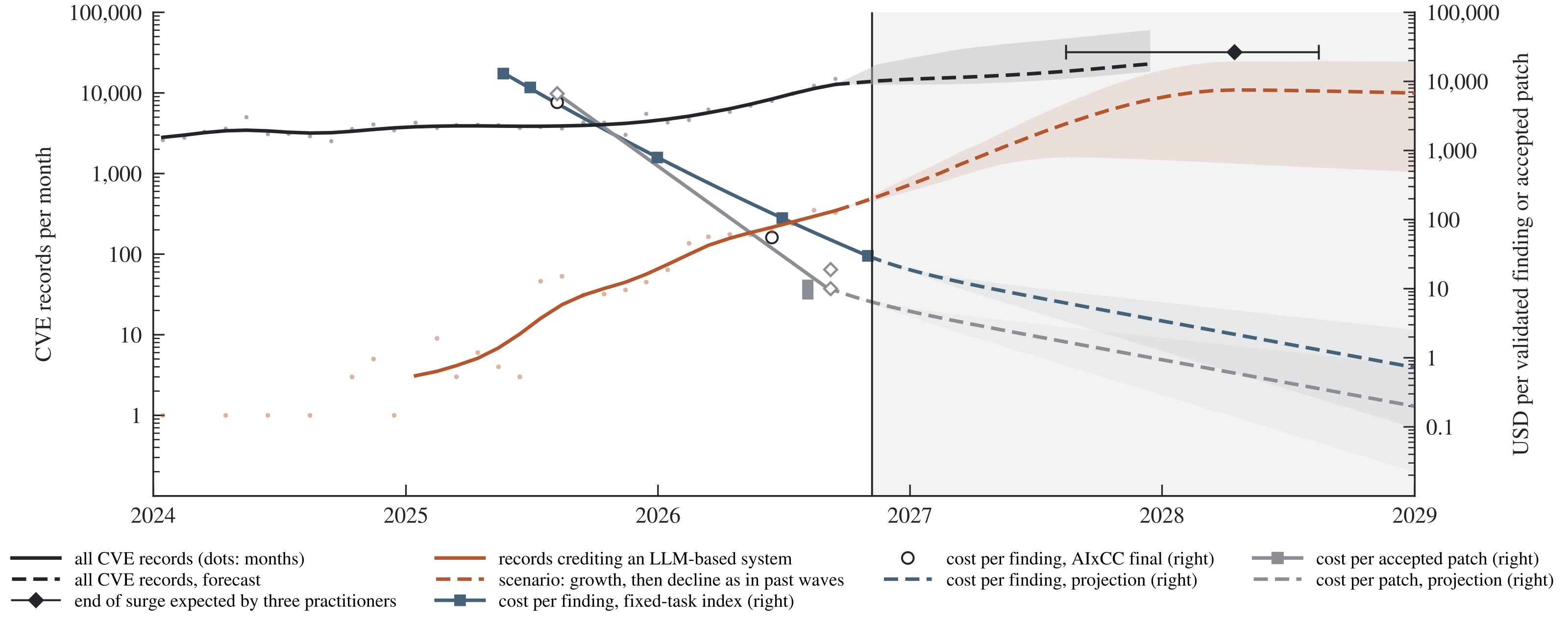
Despite surging disclosures and falling costs per validated finding, downstream response timelines have not shifted correspondingly. Across 1,417 Zero Day Initiative (ZDI) advisories, the annual median time from report to fixed release stayed between 96 and 119 days every year from 2016 through 2026, and median delays from CVE disclosure to CISA's Known Exploited Vulnerabilities catalog have not moved noticeably so far.
This report is compiled from a non-peer-reviewed preprint without independent recomputation of the underlying CVE or ZDI datasets. The authors emphasize that most CVE records omit discovery tools, making the 2,290 AI-credited records a lower bound and leaving the exact share attributable to LLMs undetermined. Vulnerability age data covers most Linux kernel entries but only 2% to 3% of other software, and post-October 2026 trend lines represent scenario projections rather than observed outcomes.
Sources and accountability
Editorial review completed.