Scientist World turns papers into executable research environments
A research proposal builds environments to evaluate and train AI scientists; results depend on the task sample and reproduced baselines.
Researchers propose Scientist World, turning paper-defined problems and reproduced methods into executable environments. The authors report an initial collection of 1,000 environments.
They also report roughly 6,400 hours of research traces for evaluation and training. This publication has not independently rerun those environments.
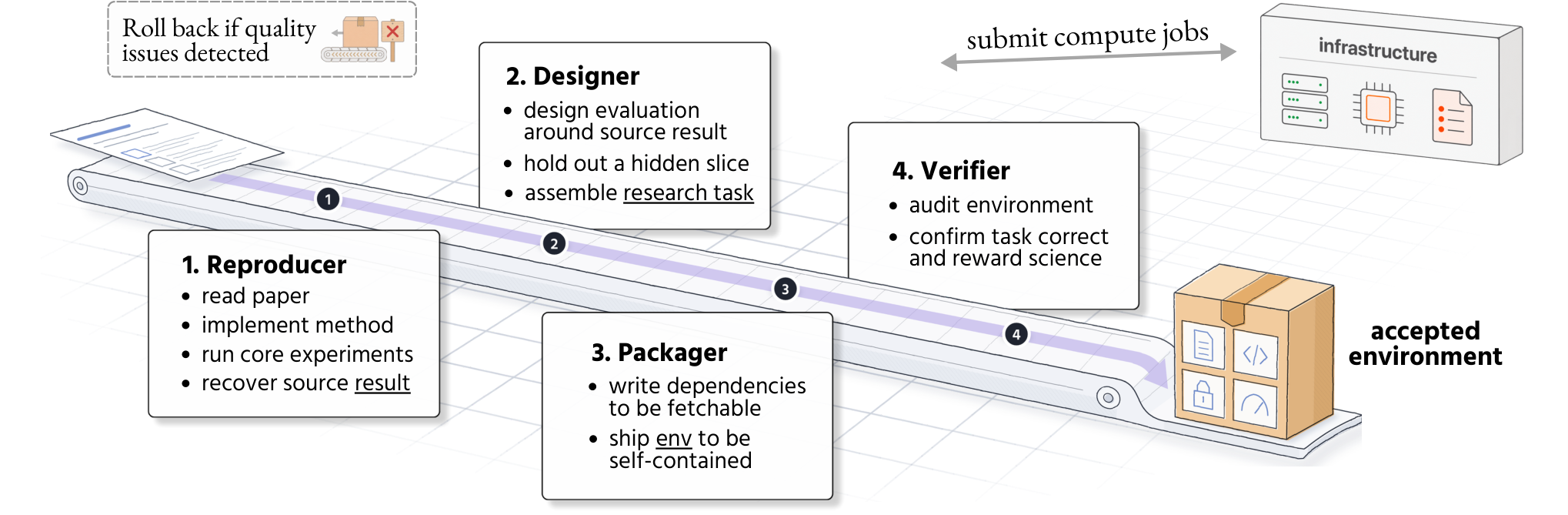
Construction comprises reproduction, task design, packaging and agent verification. New methods are scored against the reproduced source result, which provides the comparison baseline.
Model evaluation uses ten lower-compute environments, separating improvement of an existing method from designing a method from the problem alone. It does not survey every environment.
The authors report that 84% of improvement attempts and 74% of from-scratch attempts beat the reproduced baseline on held-out evaluation. These are not general odds of outperforming scientists.
The small-model experiment separates ideation from implementation: a fixed frontier model executes the ideas. Its results therefore do not demonstrate independent completion of the entire research workflow.
Sources and accountability
Editorial review completed.