Sarvam releases open-weight Prism decision model
Sarvam released Prism on November 3, a decision model built on Sarvam 105B. It takes a state, question and answer options, then scores their probabilities in a single forward pass
Sarvam released Prism on November 3, a decision model built on Sarvam 105B. It takes a state, question and answer options, then scores their probabilities in a single forward pass for fast decisions in enterprise workflows.
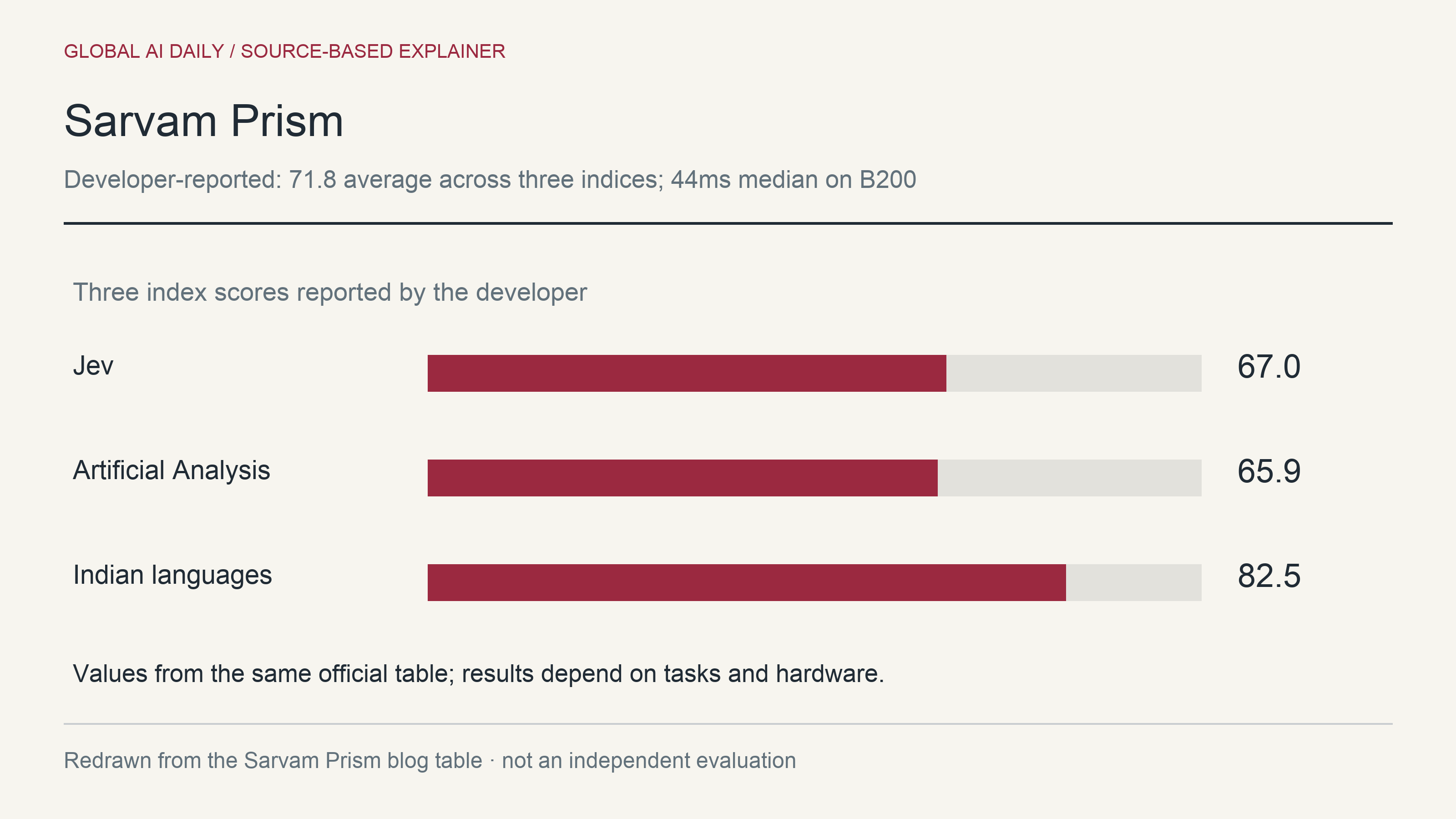
Architecturally, Prism is a LoRA fine-tune of Sarvam 105B with a scoring head for the answer options. It does not generate an explanation token by token; it maps a state, question and options to probabilities. The interface is therefore aimed at judgments among defined choices rather than free-form long answers from the same request.
In the developer’s evaluation of 25 models, Prism averaged 71.8 across three indices with a median response time of 44 milliseconds on B200 hardware. These findings come from Sarvam’s tests and depend on tasks and hardware conditions.
The 71.8 average combines the Jev Decision Index, Sarvam’s recreation of an Artificial Analysis decision test, and its internal Indian-language benchmark. The latter two include developer-defined material or adaptations. The 44 ms figure comes from its B200 testing, while reported timings for API-only models are distinguished from locally measured results in the source table.
Sarvam also examines whether confidence scores track observed errors. It scores options in a fixed order and maps probabilities back to their original names to reduce sensitivity to option ordering. These choices target workflows using probability thresholds to trigger actions. Suitability for a specific business action still requires evaluation on the relevant task and data.
Weights are released under Apache 2.0, with API access also offered. Documentation lists yes/no, choice and ordered-score questions. This version does not support image or streaming input and requires suitable memory resources for deployment.
Sources and accountability
Editorial review completed.