Deep Principle releases Hydrogen-1.0 for scientific research
Deep Principle released Hydrogen-1.0 on November 2, post-trained from GLM-5.3 for scientific research. It combines chemistry, materials and life-science knowledge with experimental
Deep Principle released Hydrogen-1.0 on November 2, post-trained from GLM-5.3 for scientific research. It combines chemistry, materials and life-science knowledge with experimental records and discovery trajectories, with weights under the MIT licence.
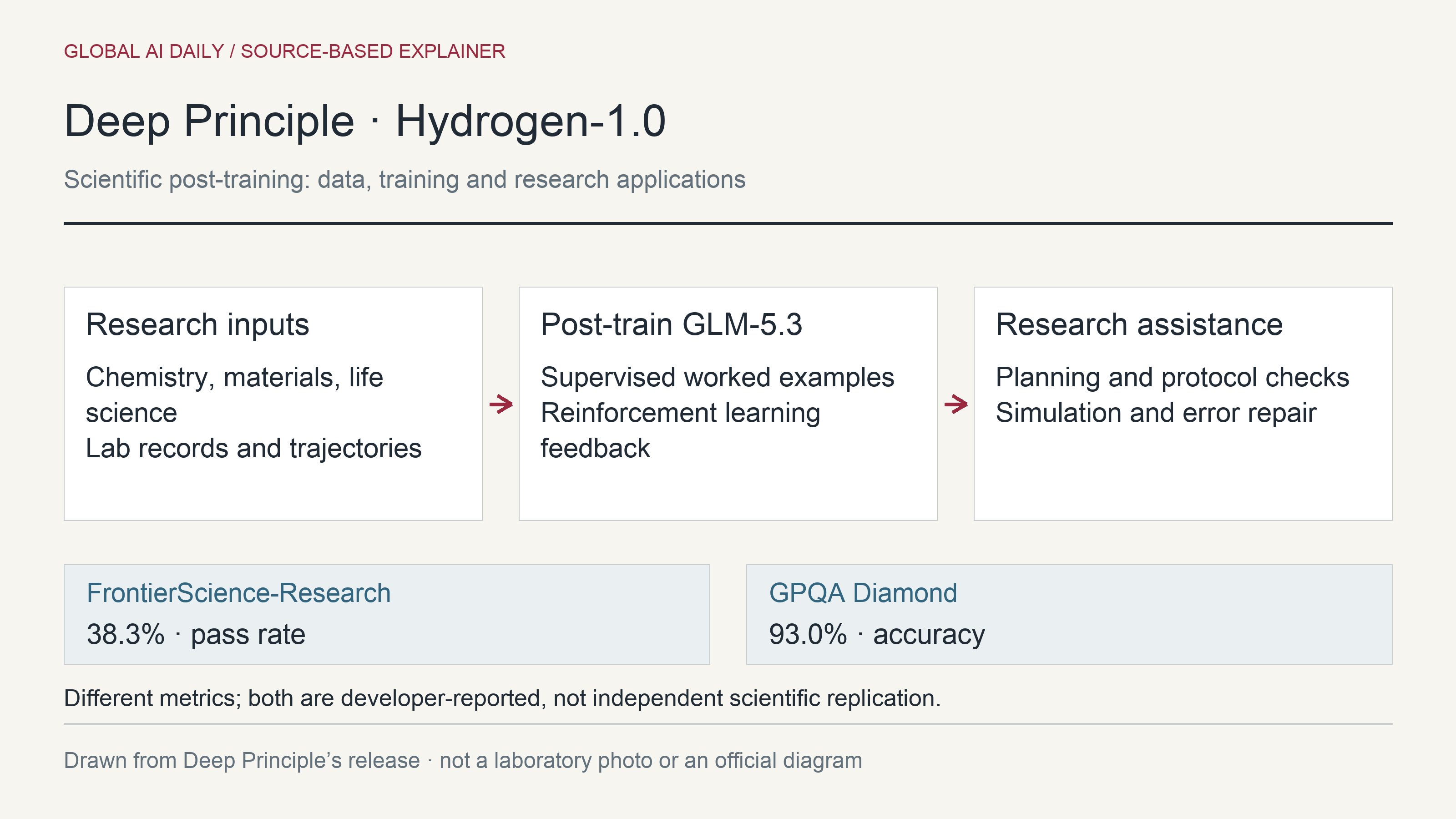
The developer emphasises learning from more than final correct answers. Research intent, procedures, observations, failed attempts and revisions remain connected in laboratory records and discovery trajectories. These materials are intended to teach relationships between a choice, its evidence and the next step, rather than only the recall of scientific knowledge.
The developer reported a 38.3% solve rate on FrontierScience-Research and 93.0% accuracy on GPQA Diamond. These are developer-reported evaluations rather than independently replicated experimental findings.
Examples in the technical article include writing and running a polymer molecular-dynamics workflow, repairing a topology error and rerunning it, and translating an experimental plan into checkable laboratory instructions. A virtual rehearsal checks equipment capabilities, action dependencies and prerequisites. These illustrate developer workflows rather than validate reliability across arbitrary experiments.
Training combines supervised fine-tuning with reinforcement learning. Worked examples cover reasoning, planning, protocol design and analysis, while feedback on research outcomes is used to improve decisions. The description separates scientific scenarios, laboratory records and materials-discovery trajectories as learning sources, aiming to improve choices about what to investigate next under uncertainty.
The weights can be downloaded, and access is also offered through the NeuroSpark API or Mira. The release does not include all training data and recipes. Outputs still require checking against assumptions, evidence and experimental conditions.
Sources and accountability
Editorial review completed.